HepG2 Cell Line: A Versatile Model for Liver Cancer and Hepatic Function Research
The HepG2 cell line is a human hepatocellular carcinoma (HCC) model originally derived from the liver tumor of a 15-year-old Caucasian male diagnosed with a well-differentiated hepatoblastoma. Since its establishment, HepG2 has become one of the most widely used hepatic cell lines in biomedical research due to its retention of key liver-specific functions and its suitability for modeling various aspects of liver biology and cancer pathogenesis.
Morphologically, HepG2 cells exhibit epithelial characteristics and form adherent monolayers under standard culture conditions. Despite their tumor origin, HepG2 cells maintain differentiated hepatic functions, including the synthesis and secretion of major plasma proteins such as albumin, transferrin, fibrinogen, and alpha-fetoprotein. These features make the cell line particularly useful for evaluating liver-specific gene expression, protein synthesis, and metabolic processes.
One of the primary applications of HepG2 cells is in the study of hepatic drug metabolism. The line expresses several cytochrome P450 (CYP) enzymes and phase II conjugation enzymes, although expression levels of certain isoforms may be lower compared to primary human hepatocytes. Nevertheless, HepG2 is widely employed in ADME (absorption, distribution, metabolism, and excretion) studies, especially in high-throughput drug screening, hepatotoxicity assays, and enzyme induction experiments.
In cancer research, HepG2 serves as a reproducible model for investigating molecular mechanisms underlying hepatocarcinogenesis, including oncogene regulation, tumor suppressor pathways, and cellular responses to chemotherapeutic agents. Its compatibility with transfection protocols facilitates functional genomic studies, gene reporter assays, and RNA interference-based screens. Additionally, HepG2 can be used to establish xenograft tumors in immunocompromised mice, providing a platform for in vivo evaluation of anti-cancer therapeutics.
HepG2 cells have also been instrumental in studying non-cancerous liver processes such as lipid metabolism, glucose homeostasis, and viral infection, including hepatitis B virus (HBV) replication. While they do not exhibit all the metabolic and enzymatic features of primary hepatocytes, their stability, ease of culture, and functional relevance make HepG2 a practical and reliable tool for liver-related research.
In summary, the HepG2 cell line represents a valuable in vitro system for exploring both oncogenic and physiological properties of human hepatocytes. Its widespread adoption in pharmaceutical and academic settings underscores its utility in bridging the gap between basic liver biology and translational research.
Altogen Biosystems’ transfection reagents (Catalog #2067, #2068, #2069) in HepG2 hepatocellular carcinoma cells. Western blot analysis of GAPDH expression demonstrates effective gene silencing via siRNA and overexpression via plasmid DNA. A reduction in GAPDH signal in siRNA-treated cells and increased expression in DNA-transfected cells confirm the functional delivery of both nucleic acid types.
These results highlight the utility of Altogen’s reagents for precise gene modulation in liver cancer models. Applications include RNAi-mediated target validation, plasmid-driven gene function studies, and drug response profiling in hepatic cells. The ability to manipulate gene expression in HepG2 cells supports high-throughput screening, toxicology testing, and molecular pathway analysis in liver disease and oncology research.
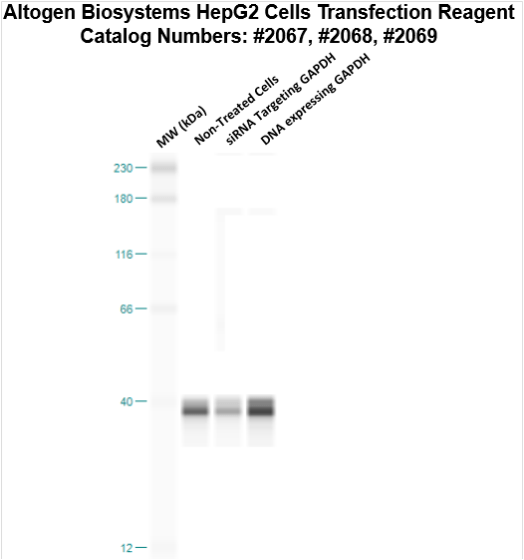
Protein expression of GAPDH in HepG2 cells. DNA plasmid expressing GAPDH or siRNA targeting GAPDH were transfected into HepG2 cells following Altogen Biosystems transfection protocol. At 72 hours post-transfection the cells were analyzed by Western Blot for protein expression levels (normalized by total protein, 10 µg of total protein loaded per each well). Untreated cells used as a negative control.