
Hepa 1-6 Cell Line: A Murine Model for Hepatocellular Carcinoma Research
Hepa 1-6 is a murine hepatoma cell line derived from a BW7756 liver tumor in a male C57L mouse. This cell line is widely used as an immunocompetent model of hepatocellular carcinoma (HCC) due to its origin from a syngeneic host and its compatibility with in vivo transplantation in immune-competent C57L and C57BL/6 mice. Hepa 1-6 cells retain many characteristics of hepatocytes while exhibiting tumorigenic behavior, making them highly relevant for liver cancer research in preclinical settings.
These cells display epithelial morphology and grow as adherent monolayers in vitro. Hepa 1-6 cells express typical hepatic markers, including albumin and alpha-fetoprotein (AFP), and exhibit functional metabolic activity. Although murine cytochrome P450 expression is less diverse than in human hepatocytes, the line is still useful for studying hepatic biotransformation, detoxification processes, and xenobiotic metabolism.
A key advantage of Hepa 1-6 is its application in immunocompetent mouse models, allowing researchers to study tumor-immune interactions, immunotherapy responses, and liver-specific inflammatory pathways. This distinguishes Hepa 1-6 from human HCC lines, which typically require immunodeficient hosts. The cell line is often used in syngeneic tumor models to evaluate cancer immunotherapy agents, checkpoint inhibitors, and tumor microenvironment dynamics in a fully functional immune system.
In summary, Hepa 1-6 is a valuable tool in liver cancer research, particularly for studies requiring immune-competent mouse models. Its utility in tumor biology, immuno-oncology, and toxicology makes it a preferred murine HCC model for in vivo experimentation and translational research.
The efficacy of Altogen Biosystems’ transfection reagents (Catalog #6820, #6821, #6822) in delivering nucleic acids to Hepa 1-6 murine hepatoma cells. The experiment evaluates Lamin A/C protein expression following transfection with either a DNA construct encoding Lamin A/C or siRNA targeting Lamin A/C, compared to non-treated controls. The band around 70 kDa, corresponding to Lamin A/C, shows increased expression in DNA-transfected cells and decreased intensity in siRNA-treated cells.
This image validates the application of Altogen reagents for both gene overexpression and knockdown in Hepa 1-6 cells, making them suitable for murine liver cancer research. These tools support studies of nuclear envelope biology, transcriptional regulation, and structural proteins in hepatocytes. Additionally, the ability to manipulate gene expression in an immunocompetent murine liver cancer model enhances translational applications in oncology, immunology, and preclinical therapeutic development.
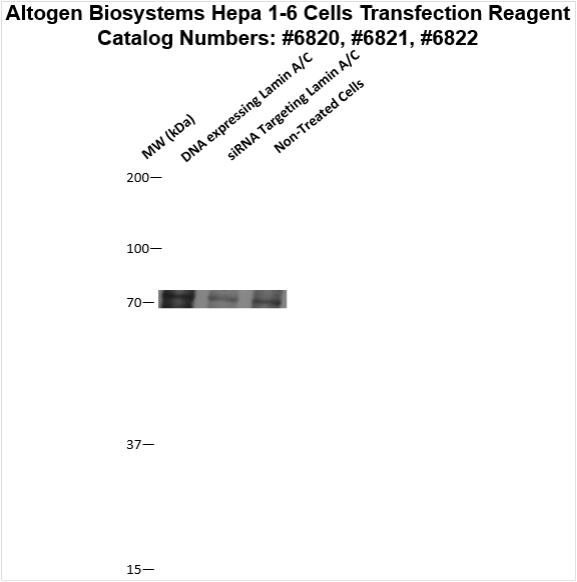
Protein expression of Lamin A/C in Hepa 1-6 cells. DNA plasmid expressing Lamin A/C or siRNA targeting Lamin A/C were transfected into Hepa 1-6 cells following Altogen Biosystems transfection protocol. At 72 hours post-transfection the cells were analyzed by Western Blot for protein expression levels (normalized by total protein, 10 µg of total protein loaded per each well). Untreated cells used as a negative control.

© Copyright 2024. All rights reserved.